Childcare illness exclusion: when to keep your child home
By Diego Cohen, Managing Editor · Updated 2026-11-08
Every parent faces the “is this sick enough to stay home” call sooner or later. The answer comes from published guidance, and your service’s written policy decides which version it applies.
Childcare illness exclusion periods in Queensland come from 2 sources, the Queensland Health “Time Out” poster and the NHMRC’s Staying Healthy guide, and they differ in places. For gastro the rule is 24 hours without diarrhoea or vomiting, and 48 hours for norovirus (Queensland Health). Ask your service which source its policy follows, and see your GP for a specific illness.
How long does an illness exclusion last for each condition?
Illness exclusion periods for 8 common conditions are in the table below. Each row names the source. The Queensland Health poster calls itself an assistive tool that does not replace clinical judgement, and the NHMRC guide (Staying Healthy, 6th edition, 2024) is mostly symptom-based.
| Condition | Exclude until | Source |
|---|---|---|
| Diarrhoea or vomiting (gastro) | No diarrhoea or vomiting for at least 24 hours | Both |
| Norovirus | No diarrhoea or vomiting for at least 48 hours | Both |
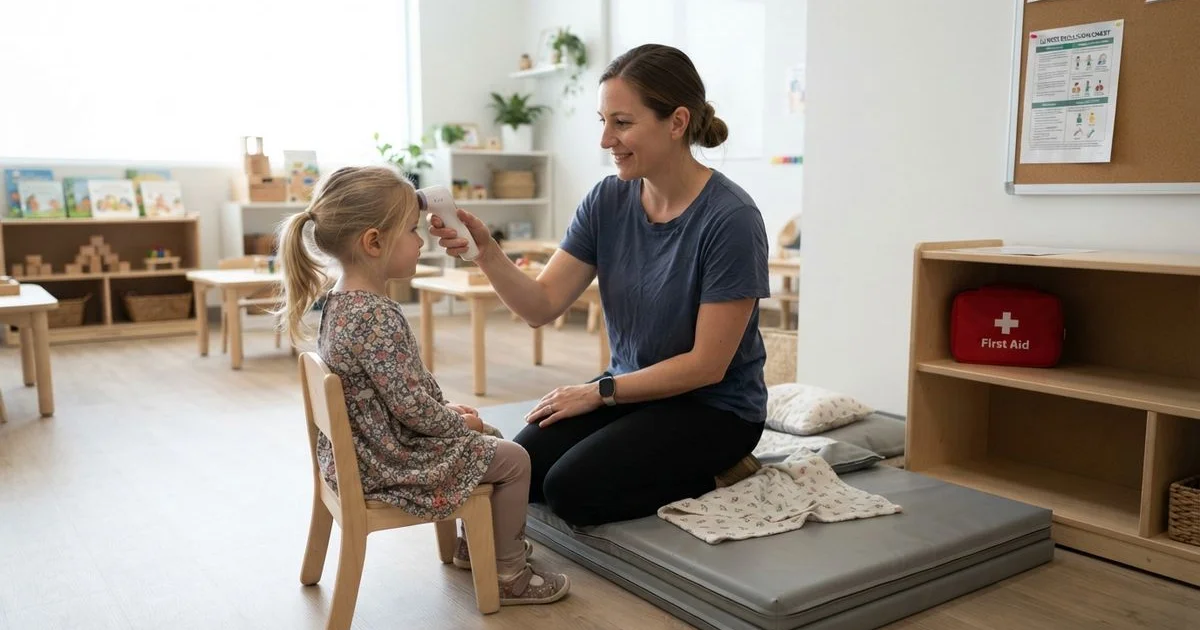
| Fever | Temperature remains normal. A fever is over 38.0 degrees Celsius | NHMRC |
| Influenza-like illness | Symptoms have resolved, normally 5 to 7 days. NHMRC sets no fixed days and a child with a cough would not usually be excluded | Queensland Health and NHMRC differ |
| Conjunctivitis | Discharge from the eyes has stopped, unless a doctor diagnoses a non-infectious cause | Both |
| Hand, foot and mouth disease | All blisters have dried | Both |
| Head lice | Not excluded if effective treatment starts before the next attendance day | Both |
| Chickenpox | All blisters have dried and crusted (Queensland Health), or dried (NHMRC) | Differ |
3 details sit outside the table. Anyone who prepares or serves food is excluded for 48 hours after gastro, in both sources. Contacts of a child with chickenpox are not excluded in either source. The NHMRC says blisters usually take at least 5 days to dry after the rash first appears in non-immunised children, and less in immunised children. The Queensland Health poster also says 2 or more gastro cases in the same place should be notified to the public health unit, as should a single case in a food handler (Queensland Health, NHMRC).
How do you apply an illness exclusion at 6am?
Most mornings, an illness exclusion decision comes down to the periods in the table, which come from Queensland Health and the NHMRC. Has there been any diarrhoea or vomiting in the last 24 hours, or 48 hours if norovirus is suspected? Is your child’s temperature over 38.0 degrees Celsius, the NHMRC definition of a fever? Are there blisters, eye discharge or head lice that match a row in the table? If any answer is yes, find the row and phone your service.
A worked example, using our arithmetic: if a child last vomits at 3pm on a Monday, 24 hours without vomiting or diarrhoea is reached at 3pm on Tuesday, and 48 hours for norovirus at 3pm on Wednesday. For a fever, the NHMRC says a child who went home with a fever but has a normal temperature the next morning can return, and a child who wakes with a fever stays home. The NHMRC gives 36.5 to 38.0 degrees Celsius as normal.
What happens if your child is sick at the service?
When a child is sick at the service, the illness exclusion rules start with a phone call. A service must have an infectious diseases policy and must notify a parent of an infectious disease occurrence at a centre-based service as soon as practicable. It must tell you about any incident, injury, trauma or illness involving your child within 24 hours (National Regulations, regulations 86, 88 and 168). For a fever, the NHMRC says the child should go home as soon as possible.
Ask the service how quickly it expects a pick-up and who it calls if you cannot be reached.
Do you still pay during an illness exclusion?
Whether a service charges for a day your child is absent is its own policy, and we have found no primary source for what is typical. A missed day can be costly: the Queensland average hourly fee was $14.15 in the June quarter 2026, before subsidy (Department of Education). A 10-hour day at that rate is $141.50 by our arithmetic. That is a state average and our calculation, not a Deception Bay price, so ask each service for its fee schedule. None of the 10 listings with website details mentions an illness policy.
Child Care Subsidy can help when a fee is charged. You can get CCS for up to 42 allowable absence days per child each financial year, for any reason, with no evidence needed. Extra absences are available once the 42 are used, including when the child is ill. Absences are only paid on days your child would normally attend, and the service must be told (Services Australia). Ask the service when you enrol how it records absences and whether it offers any fee relief on sick days.
What should you tell the service before an illness exclusion comes up?
3 things are worth telling the service in advance, so an illness exclusion does not catch either of you out.
- Any condition that can look like an infectious illness, such as a long-running cough or a skin condition that is not infectious. Both sources make an exception when a doctor diagnoses a non-infectious cause of conjunctivitis, and the NHMRC makes one for a fever with a known non-infectious cause, so ask your GP whether a note would help.
- A backup pick-up contact. Name one at enrolment, and decide with a partner or relative who goes when the call comes.
- Medical details. If your child has an allergy, the service must ask you for a medical management plan, and Food allergies and mealtime safety in childcare centres covers what else it must put in place.
Frequently asked questions
- How long should my child stay home after vomiting or diarrhoea?
- Both Queensland Health and the NHMRC say to exclude a child until there has been no diarrhoea or vomiting for at least 24 hours. For norovirus, both sources say at least 48 hours. Anyone who prepares or serves food is also excluded for 48 hours. Check your service's written policy, and see your GP if symptoms continue.
- What counts as a fever for childcare?
- The NHMRC defines a fever as a temperature over 38.0 degrees Celsius. The child should go home as soon as possible and be excluded until their temperature remains normal, which the NHMRC gives as 36.5 to 38.0 degrees. If a child went home with a fever but their temperature is normal the next morning, they can return. The Queensland Health poster has no separate fever row.
- Does a cough mean my child has to stay home from childcare?
- Not always. The NHMRC says a child with a cough would not usually be excluded. For influenza-like illness, the Queensland Health poster says to exclude until symptoms have resolved, normally 5 to 7 days. The 2 sources differ, so ask your service which one it follows, and ask your GP about your child's symptoms.
- Do I still pay if my child is absent sick?
- Charging for absent days is each service's own policy, so ask when you enrol. Child Care Subsidy can cover up to 42 allowable absence days per child each financial year for any reason, with extra absences available once those are used if the child is ill. CCS only helps on days your child would normally attend and when a fee is charged.