Food allergies and mealtime safety in childcare centres
By Diego Cohen, Managing Editor · Updated 2026-11-08
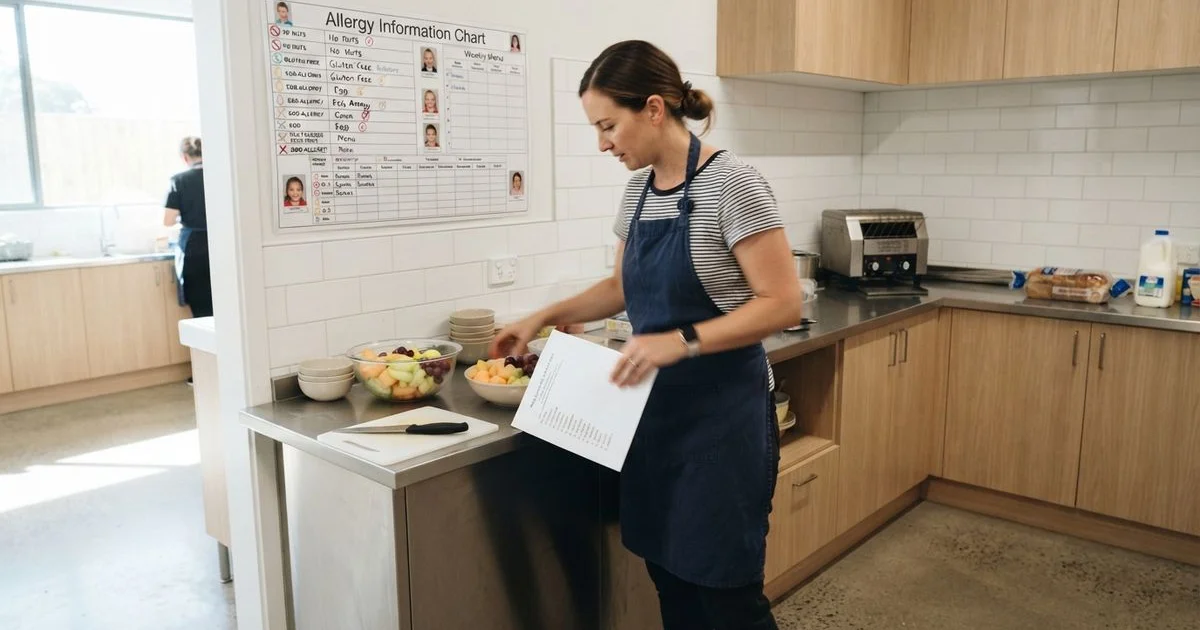
For a child with food allergies, mealtime is the part of the childcare day that needs a specific plan. Queensland law sets a minimum, and your questions cover what happens above it.
A Queensland childcare service must have a medical conditions policy, and for a child with food allergies it must require a medical management plan, a risk minimisation plan and a communications plan (National Regulations, regulation 90). At least 1 staff member on duty must hold current anaphylaxis management training. A reaction that needs hospital is a serious incident, which the service must report to the regulator within 24 hours.
What plans must a service have for a child with food allergies?
A childcare service must have 3 plans in place for a child with food allergies or another relevant medical condition. The service’s medical conditions policy must require:
- A medical management plan, which you provide and which the service must follow in an incident.
- A risk minimisation plan developed with you, covering safe food handling, preparation and service, notifying parents of known allergens, and making sure all staff can identify your child, the plan and where the medication is.
- A communications plan.
The service must give you a copy of the policy if it knows your child has an allergy (National Regulations, regulations 90 and 91).
The medical conditions policy must also cover asthma, diabetes and a diagnosis that a child is at risk of anaphylaxis, so the same 3 plans apply to other relevant medical conditions. The sources we read do not say the medical management plan must come from a GP, so ask the service what it accepts.
Who is trained to respond to food allergies and anaphylaxis?
For a child with food allergies, a centre-based service must have at least 1 staff member or nominated supervisor on duty and immediately available in an emergency for each of the current approved trainings below:
- First aid.
- Anaphylaxis management.
- Emergency asthma management.
A family day care service must make sure every educator holds all 3 (National Regulations, regulation 136).
The minimum is 1 person for each training, so ask how many staff are trained, who is on the roster at mealtimes, and how relief staff learn your child’s plan.
What happens if a child with food allergies has a reaction?
For a child with food allergies, an anaphylaxis reaction for which the child attended, or ought reasonably to have attended, hospital is a serious incident. The approved provider must notify the regulator within 24 hours and must tell you within 24 hours (National Regulations, regulations 12, 86 and 176). The regulator in Queensland is the Queensland Early Childhood Regulatory Authority, run by the Department of Education.
A severe asthma attack or a seizure is treated the same way when the child attended, or ought reasonably to have attended, hospital. Ask the service what its response would be in the first minutes, where your child’s medication is kept and who can reach it.
What did the 2026 ASCIA update change for childcare services?
ASCIA and Allergy and Anaphylaxis Australia, together the National Allergy Council, updated the best practice guidelines for anaphylaxis prevention and management in schools and children’s education and care services in 2026. The update made 4 changes: the term “adrenaline devices”, which includes general use devices; new staff anaphylaxis drills; updated ASCIA Action Plan images; and an off-site activities checklist (ASCIA). ASCIA issued the news item on 26 May 2026.
Ask whether the service has adopted the 2026 guidelines, and how it runs anaphylaxis drills for its staff.
What does the directory show about meals and food allergies?
Our directory shows that some services list meals, but none records food allergy practice. Of the 10 listings that carry website details, 4 list meals among their services and none mentions allergy management (website details collected 9 August 2026, not independently verified). Our listings cannot tell you how a service handles your child’s allergen, so that comes from the director.
What should you ask on a tour about food allergies?
6 questions cover the ground. Ask for the answers in writing where you can.
| Question | Why it matters |
|---|---|
| Can I see your medical conditions policy? | The service must give you a copy if it knows your child has an allergy |
| Who writes the risk minimisation plan, and how often is it reviewed? | The plan must be developed with you, and the sources we read give no review date |
| How are meals prepared and served so my child’s allergen is avoided? | Safe food handling, preparation and service are part of the plan |
| How many staff hold anaphylaxis training, and who is on each shift? | The legal minimum is 1 person for each training |
| Where are my child’s plan and medication kept, and who can reach them? | The plan must make sure all staff can identify your child, the plan and where the medication is |
| How do you run staff anaphylaxis drills, and what happens on excursions? | The 2026 ASCIA update adds staff anaphylaxis drills and an off-site activities checklist |
How do you keep the food allergy plan current?
The sources we read set no review interval for these plans. Ask the service 3 things about food allergies: who updates the risk minimisation plan, how often, and how a change in your child’s allergy reaches every educator, including relief educators. Confirm the answers when your child’s allergy changes, whether that is a new allergy, an outgrown one or a change in severity.
If your child starts care with a medical condition, Childcare illness exclusion: when to keep your child home sets out the exclusion periods a service applies.
Frequently asked questions
- Does a childcare service need a plan for my child's food allergies?
- Yes. For a child with food allergies, regulation 90 of the National Regulations requires the service's medical conditions policy to require 3 plans: a medical management plan you provide, a risk minimisation plan developed with you, and a communications plan. The service must give you a copy of the policy if it knows your child has an allergy. Ask to see the policy before you enrol.
- Who must be trained to give an adrenaline device at childcare?
- A centre-based service must have at least 1 staff member or nominated supervisor on duty and immediately available in an emergency for each of 3 current approved trainings: first aid, anaphylaxis management and emergency asthma management. A family day care educator must hold all 3. Ask how many staff are trained and how relief staff are briefed.
- What happens if my child has an allergic reaction at childcare?
- A reaction that needs hospital, or ought reasonably to have needed it, is a serious incident. The approved provider must notify the Queensland Early Childhood Regulatory Authority within 24 hours and must tell you within 24 hours. Ask the service what its first response is, where your child's medication is kept and who can reach it.
- What changed in the 2026 ASCIA guidelines for childcare?
- ASCIA and Allergy and Anaphylaxis Australia updated the best practice guidelines for children's education and care services in 2026. The update made 4 changes: the term adrenaline devices, new staff anaphylaxis drills, updated ASCIA Action Plan images and an off-site activities checklist. Ask your service whether it has adopted the 2026 guidelines.